Octave Courses
Octave courses can help you learn numerical computing, data visualization, algorithm implementation, and mathematical modeling. You can build skills in matrix operations, statistical analysis, and signal processing techniques. Many courses introduce tools like Octave's integrated development environment and libraries for optimization, enabling you to apply these skills in real-world projects and research.
Popular Octave Courses and Certifications

Skills you'll gain: Plot (Graphics), Scripting, Scientific Visualization, Graphing, Scripting Languages, Data Visualization Software, Code Reusability, Debugging, Matlab, Numerical Analysis, Mathematical Software, Applied Mathematics, Data Manipulation, Linear Algebra
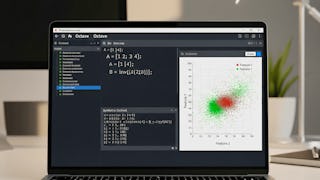
Skills you'll gain: Plot (Graphics), Scientific Visualization, Text Mining, Statistical Analysis, Matlab, Statistical Methods, Data Visualization, Visualization (Computer Graphics), Descriptive Statistics, Unstructured Data, Data Analysis, Statistical Software, Computer Programming, Mathematical Software, Applied Machine Learning, Data Transformation, Data Preprocessing, Data Manipulation, Analytics, Data Processing

Skills you'll gain: Mathematical Software, Software Installation, Numerical Analysis, Mathematical Modeling, Trigonometry, Programming Principles, Functional Design, Code Reusability, Data Manipulation, Computational Logic, Linear Algebra, Arithmetic
Coursera
Skills you'll gain: Retrieval-Augmented Generation, Generative AI, LangChain, LLM Application, Large Language Modeling, Embeddings, Vector Databases, AI Orchestration, Model Evaluation
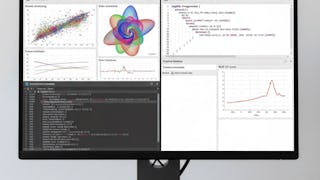
Skills you'll gain: Plot (Graphics), Scripting, Scientific Visualization, Graphing, Scripting Languages, Data Visualization Software, Scalability, Code Reusability, Text Mining, Statistical Analysis, Time Series Analysis and Forecasting, Matlab, Mathematical Software, File I/O, Software Installation, Numerical Analysis, Mathematical Modeling, Predictive Modeling, Python Programming, Data Analysis
University of Colorado System
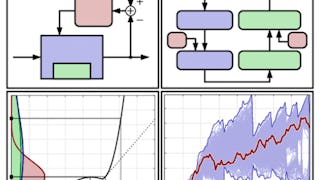
Skills you'll gain: Bayesian Network, Linear Algebra, Numerical Analysis, Mathematical Modeling, Estimation, Matlab, Statistical Modeling, Markov Model, Simulations, Integral Calculus, Correlation Analysis, Probability, Simulation and Simulation Software, Probability & Statistics, Statistical Methods, Applied Mathematics, Probability Distribution, Predictive Analytics, Engineering Analysis, Control Systems
What brings you to Coursera today?

Universidad Nacional Autónoma de México
Skills you'll gain: Digital Signal Processing, Musical Composition, Electronic Hardware, Music, Electronic Components, Electronics, Digital Communications, Electronic Systems, Hardware Design, Patch Management, Embedded Systems, Instrumental Music, System Configuration, Algorithms, Embedded Software, Performance Tuning, Data Import/Export, Music Performance, Programming Principles, Other Programming Languages

Skills you'll gain: Scalability, Time Series Analysis and Forecasting, File I/O, Predictive Modeling, Code Reusability, Programming Principles, Data Import/Export, Matlab, Scripting, Data Analysis, Data Processing, Computational Logic, Data Manipulation, Applied Machine Learning, File Management, Functional Design

Google Cloud
Skills you'll gain: Prompt Engineering, Gemini, Google Gemini, Prompt Patterns, Multimodal Prompts, Prompt Engineering Tools, Generative AI, LLM Application, Model Optimization, Fine-tuning, Model Deployment, Prototyping

Skills you'll gain: Retrieval-Augmented Generation, Vector Databases, Generative AI, Performance Tuning, Data Migration, Grafana, LangChain, LLM Application, Metadata Management, Containerization, Document Management, Data Infrastructure, Role-Based Access Control (RBAC), Database Architecture and Administration, Infrastructure Architecture, Large Language Modeling, Query Languages, Quantitative Research, Data Modeling, Docker (Software)

Google Cloud
Skills you'll gain: Google Gemini, Gemini, Vibe coding, Web Development Tools, Generative AI Agents, Generative AI, Application Development, LLM Application, Google Cloud Platform, Software Development Tools, Cloud Development, Development Environment, Web Development, Web Applications, Secure Coding, Command-Line Interface, Application Security, Debugging
University of Colorado System
Skills you'll gain: Linear Algebra, Mathematical Modeling, Estimation, Matlab, Statistical Modeling, Simulations, Control Systems, Probability, Simulation and Simulation Software, Probability & Statistics, Statistical Methods, Probability Distribution
In summary, here are 10 of our most popular octave courses
- Octave Programming: Analyze, Apply & Implement: EDUCBA
- Octave for Machine Learning: Analyze & Visualize: EDUCBA
- GNU Octave: Apply, Implement & Design Functions: EDUCBA
- Boost RAG with Chroma: Coursera
- Octave for Machine Learning: Data Analysis Mastery: EDUCBA
- Applied Kalman Filtering: University of Colorado System
- Programación musical con software libre: Universidad Nacional Autónoma de México
- Octave Machine Learning: Apply, Analyze & Build: EDUCBA
- Introduction to Vertex AI Studio: Google Cloud
- Chroma, Weaviate & Production RAG Deployment: Coursera










