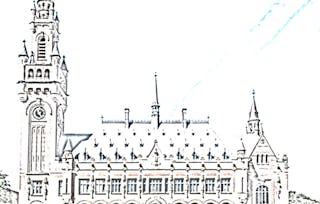
International Law in Action explains the functions of each international court and tribunal present in The Hague, and it looks at how these institutions address contemporary problems. On the basis of selected cases, and through interviews with judges and lawyers, you will explore the role of these courts and tribunals and their potential to contribute to global justice.
The first module of the course will investigate how judicial settlement is different from other more political forms of dispute settlement, such as negotiation and mediation. It offers a brief historical overview and introduces the judicial and arbitral bodies based in The Hague. In the remaining modules you will learn about the functions of these courts and tribunals, and some of the challenges and prospects that they face. Three cross-cutting themes tie together all of these modules: (i) The interaction between law and politics; (ii) The continuing role of State consent; and (iii) The ability of international courts and tribunals to protect the public interest and global values.
This course offers you an opportunity to gain a better insight into the functions and features of the courts and tribunals present in The Hague. You will gain a familiarity with each court or tribunal. You will develop realistic expectations of their capacity to address contemporary problems and an awareness of their limitations. You will also be able to discuss some of their most prominent cases.
If you would like to have a better understanding of international law in action in The Hague, this is definitely the course for you!
This course is free to join and to participate in. There is the possibility to get a verified certificate for the course, which is a paid option. If you want a certificate, but are unable to pay for it, you can request financial aid via Coursera
Welcome to this first week in which we will enter the world of the international judiciary with you. We will discuss the evolution of international dispute settlement in our international legal order. The leading question is: why did people start thinking about creating international courts? We will also introduce the community of international courts present in The Hague today.
The History of International Dispute Settlement in The Hague•7 minutes
Diplomatic versus Judicial International Dispute Settlement•9 minutes
Overview of the International Courts and Tribunals in The Hague•7 minutes
The Course Themes: Law and Politics, State Consent, Global Values•5 minutes
3 readings•Total 125 minutes
Meet the instructor & her team•5 minutes
Required Reading•60 minutes
Recommended Reading•60 minutes
1 assignment•Total 30 minutes
An Introduction to the International Courts and Tribunals in The Hague•30 minutes
1 discussion prompt•Total 30 minutes
Introduce yourself!•30 minutes
1 plugin•Total 2 minutes
Discover The World at Leiden University [video]•2 minutes
The International Court of Justice (ICJ)
Module 2•4 hours to complete
Module details
This week we are going to explore the principle judicial organ of the United Nations—the International Court of Justice. This Court has dual functions as an institution that settles disputes between States, and as an advice giver within the UN system. We will explore the limitations that the Court faces in its fulfilment of these functions as well as its potential as an institution, particularly in the context of disputes involving the protection of the environment. From this week onwards, you will also be able to start working on the peer assignment. All relevant information with regard to the peer assignment can be find below. We look forward to reading how you view the future of the international courts and tribunals in The Hague!
What's included
5 videos2 readings1 assignment1 peer review
Show info about module content
5 videos•Total 52 minutes
An Introduction to the International Court of Justice•11 minutes
The ICJ's Contentious Jurisdiction•8 minutes
Advisory Opinions of the International Court of Justice•8 minutes
The International Court of Justice and the Protection of the Environment•8 minutes
Interview with Judge Christopher Greenwood•17 minutes
2 readings•Total 120 minutes
Required Reading•60 minutes
Recommended Reading•60 minutes
1 assignment•Total 30 minutes
The International Court of Justice•30 minutes
1 peer review•Total 60 minutes
The Future of International Courts and Tribunals in The Hague•60 minutes
The Arbitration of International Disputes
Module 3•3 hours to complete
Module details
This week, we will explore the world of international arbitration. More specifically, we will focus on the Permanent court of arbitration, inter-state arbitration and investor-state arbitration. Through our videos, you will discover the history and characteristics of arbitration and you will understand how its functioning is impacted by the dynamics at play within the international and domestic societies. You will also come to realize the importance of public interests in the disputes settled through arbitration and you will learn how they are taken into account in international arbitration.
What's included
5 videos2 readings1 assignment
Show info about module content
5 videos•Total 44 minutes
Arbitration and the Permanent Court of Arbitration•6 minutes
Introduction to Inter-State Arbitration•6 minutes
Introduction to Investor-state Arbitration•7 minutes
Investment Arbitration and Public Interests: Human Health•7 minutes
Interview with Brooks W. Daly•17 minutes
2 readings•Total 120 minutes
Required Reading•60 minutes
Recommended Reading•60 minutes
1 assignment•Total 30 minutes
The Arbitration of International Disputes•30 minutes
International Criminal Courts and Tribunals
Module 4•5 hours to complete
Module details
This week examines a relatively new type of international courts, namely international criminal courts, with a focus on the ICC. We will discuss ongoing cases and debates, including sensitive issues such as the prosecution of sitting Heads of States. We will also inquire whether the international community is in need of a new dedicated international terrorism tribunal.
What's included
5 videos3 readings1 assignment
Show info about module content
5 videos•Total 85 minutes
From Nuremberg to The Hague: The Renaissance of International Criminal Law•11 minutes
The International Criminal Court•14 minutes
Interview with ICC Prosecutor Fatou Bensouda•42 minutes
International Criminal Courts and Global Values: The ICC and Democracy•10 minutes
Towards an International Terrorism Tribunal?•9 minutes
3 readings•Total 180 minutes
Required Reading•60 minutes
Recommended Reading•60 minutes
Documents for Reference•60 minutes
1 assignment•Total 30 minutes
International Criminal Courts and Tribunals•30 minutes
Conclusions of the three Course Themes
Module 5•1 hour to complete
Module details
This week, we will directly focus on the three course themes that have structured our discussions in the previous modules: law and politics, state consent and global values. For each of these themes, the videos of this module will give you the opportunity to synthetize the knowledge that you have acquired over the course and to compare the various courts and tribunals that have been analyzed through the lenses of the course themes. The videos in this module will also offer you some concluding observations and insights which will stimulate you to continue to reflect on these three themes and the international courts in The Hague more generally. This week, you will also take the final exam of this course; good luck on this!
What's included
3 videos1 assignment
Show info about module content
3 videos•Total 19 minutes
Course Theme I: Law and Politics•7 minutes
Course Theme II: State Consent•5 minutes
Course Theme III: Global Values•7 minutes
1 assignment•Total 30 minutes
Final Exam•30 minutes
Instructors
Instructor ratings
Instructor ratings
We asked all learners to give feedback on our instructors based on the quality of their teaching style.
Leiden University is one of Europe's foremost research universities. This prominent position gives our graduates a leading edge and prepares them for careers both within and outside of academia. Leiden University is the oldest university in the Netherlands, founded in 1575. Our motto is: Praesidium Libertatis (Bastion of Liberty) - Freedom of spirit, thought and expression. Leiden University has a campus in Leiden and The Hague, with 7 faculties, 47 Bachelor Programmes, 79 Master Programmes and nearly 30,000 students.
"To be able to take courses at my own pace and rhythm has been an amazing experience. I can learn whenever it fits my schedule and mood."
Jennifer J.
Learner since 2020
"I directly applied the concepts and skills I learned from my courses to an exciting new project at work."
Larry W.
Learner since 2021
"When I need courses on topics that my university doesn't offer, Coursera is one of the best places to go."
Chaitanya A.
"Learning isn't just about being better at your job: it's so much more than that. Coursera allows me to learn without limits."
Learner reviews
4.8
1,222 reviews
5 stars
82.43%
4 stars
14.70%
3 stars
2.04%
2 stars
0.40%
1 star
0.40%
Showing 3 of 1222
S
SR
5·
Reviewed on Jan 3, 2017
The course was extremely informative with a holistic perspective on the functioning of various international courts as well as special courts addressing international law issues.
H
HB
5·
Reviewed on Feb 17, 2016
I think this course will be an added value to any one has interest to understand the IL principles with more focus in the Hague.
A
AM
5·
Reviewed on Jan 26, 2017
I loved this course. Videos are very clear and well structured that for me (with non-law degree) was very easy to follow and systemize my knowledge. Thank you very much.
When will I have access to the lectures and assignments?
To access the course materials, assignments and to earn a Certificate, you will need to purchase the Certificate experience when you enroll in a course. You can try a Free Trial instead, or apply for Financial Aid. The course may offer 'Full Course, No Certificate' instead. This option lets you see all course materials, submit required assessments, and get a final grade. This also means that you will not be able to purchase a Certificate experience.
What will I get if I purchase the Certificate?
When you purchase a Certificate you get access to all course materials, including graded assignments. Upon completing the course, your electronic Certificate will be added to your Accomplishments page - from there, you can print your Certificate or add it to your LinkedIn profile.
Is financial aid available?
Yes. In select learning programs, you can apply for financial aid or a scholarship if you can’t afford the enrollment fee. If fin aid or scholarship is available for your learning program selection, you’ll find a link to apply on the description page.