- Statistical Software
- Machine Learning Methods
- Bayesian Statistics
- R Programming
- Probability Distribution
- Statistical Modeling
- Probability & Statistics
- Statistical Methods
- Mathematical Modeling
- Unsupervised Learning
- Markov Model
- Classification Algorithms
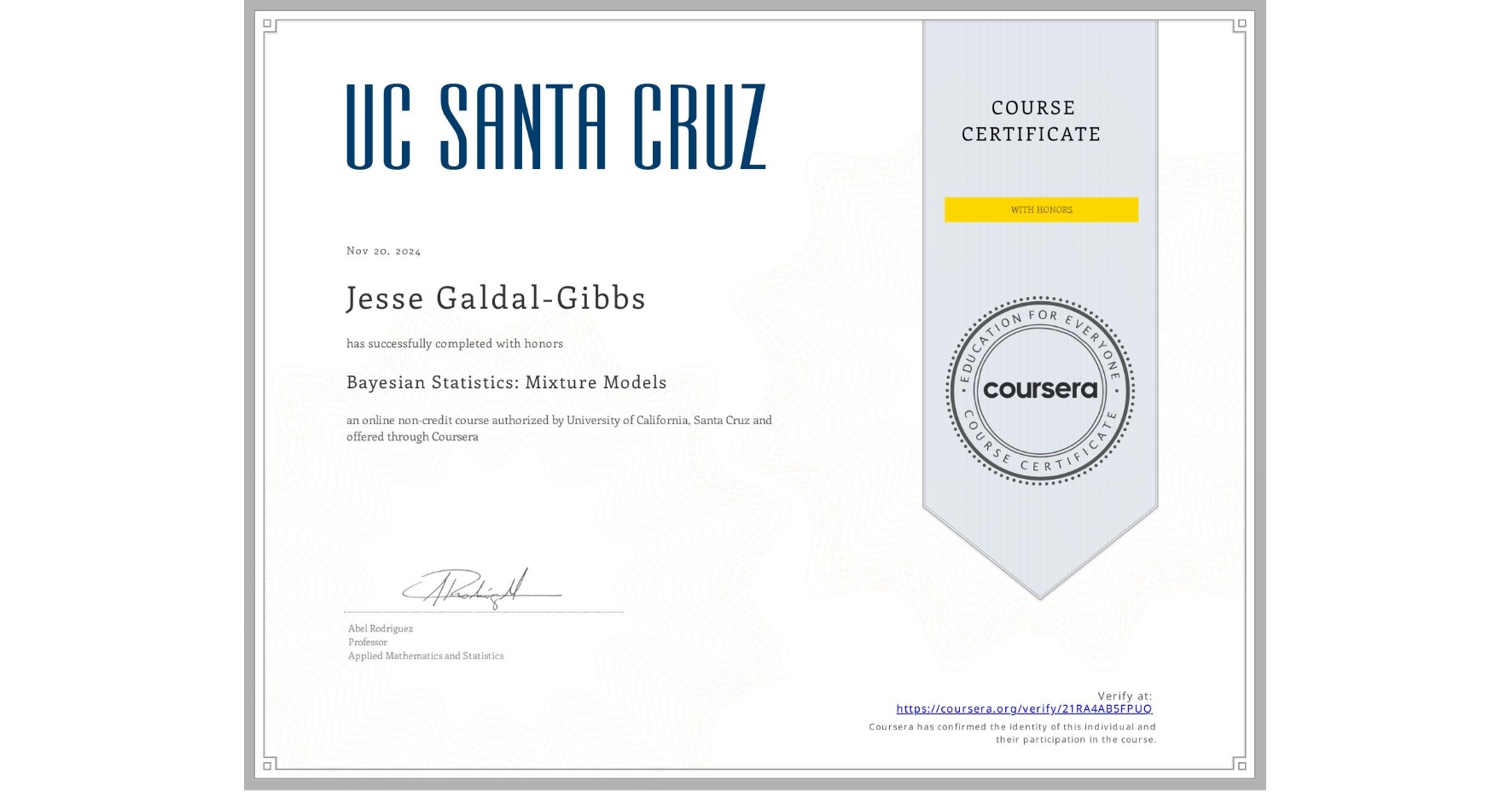
Bayesian Statistics: Mixture Models
Completed by Jesse Galdal-Gibbs
November 20, 2024
21 hours (approximately)
Jesse Galdal-Gibbs's account is verified. Coursera certifies their successful completion of Bayesian Statistics: Mixture Models
What you will learn
Explain the basic principles behind the algorithm for fitting a mixture model.
Compute the expectation and variance of a mixture distribution.
Use mixture models to solve classification and clustering problems, and to provide density estimates.
Skills you will gain