Democracy Courses
Democracy courses can help you learn about civic engagement, political theory, electoral systems, and the role of institutions in governance. You can build skills in critical thinking, public speaking, and analyzing policy impacts. Many courses introduce tools like data analysis software for interpreting voting trends and platforms for organizing community initiatives, allowing you to apply your knowledge in practical ways.
Popular Democracy Courses and Certifications

Johns Hopkins University
Skills you'll gain: Political Sciences, Policy Analysis, Social Justice, Social Sciences, Public Policies, Game Theory, Demography, Logical Reasoning, Applied Mathematics
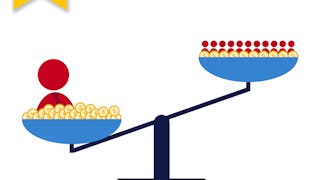 Status: Free
Utrecht University
Skills you'll gain: Lobbying, Political Sciences, Socioeconomics, Tax Laws, Social Sciences, Economics, Commercial Laws, Policy Analysis, Governance
 Status: Free
Johns Hopkins University
Skills you'll gain: Game Theory, Mathematical Modeling, Political Sciences, Combinatorics, Social Sciences, Probability, Applied Mathematics, Critical Thinking, General Mathematics, Statistical Analysis
 Status: Preview
O.P. Jindal Global University
Skills you'll gain: Policy Development, Political Sciences, Governance, Policy Analysis, International Relations, Public Policies, Social Justice, Economic Development, Public Administration, Law, Regulation, and Compliance, Case Studies
 Status: Preview
University of Copenhagen
Skills you'll gain: International Relations, Climate Change Adaptation, Political Sciences, Environmental Issue, Environmental Policy, Advocacy, Climate Change Mitigation, Systems Thinking, Policy Analysis, Social Justice, Sustainable Development, Community Organizing, Lobbying, Diplomacy, Public Policies, Innovation, Governance
 Status: Preview
Università di Napoli Federico II
Skills you'll gain: Political Sciences, Policy Analysis, Critical Thinking, Research, Social Sciences, Systems Thinking, Governance, Sociology, Interactive Learning, Research Methodologies
What brings you to Coursera today?
 Status: Free
Rutgers the State University of New Jersey
Skills you'll gain: Political Sciences, Social Justice, Social Sciences, Policy Analysis, Governance, Research, Law, Regulation, and Compliance, Economics, Ethical Standards And Conduct
 Status: Free
Rutgers the State University of New Jersey
Skills you'll gain: Political Sciences, Policy Analysis, Social Sciences, Social Justice, Economics, Policy, and Social Studies, Public Policies, Governance, Law, Regulation, and Compliance, Ethical Standards And Conduct
 Status: Free Trial
University of Pennsylvania
Skills you'll gain: Business Ethics, Case Studies, Governance, Social Impact, Ethical Standards And Conduct, Policy Analysis, Economics, Policy, and Social Studies, Socioeconomics, Social Sciences, Law, Regulation, and Compliance, Leadership Studies, Analysis, Political Sciences, Psychology, Economic Development
 Status: Free
Utrecht University
Skills you'll gain: Social Justice, Court Systems, Political Sciences, Immigration Law, Law, Regulation, and Compliance, Diversity Awareness, European History, Cultural Diversity, Social Sciences, Civil Law, Case Law, Media and Communications
 Status: Preview
University of Geneva
Skills you'll gain: Immigration Law, Social Studies, Social Justice, Community Development, Political Sciences, Social Sciences, Cultural Diversity, Public Policies, Sociology, Student Engagement
 Status: Preview
University of Michigan
Skills you'll gain: Social Justice, Responsible AI, Disabilities, Innovation, Diversity Awareness, Social Impact, Socioeconomics, Human Centered Design, Sustainable Systems, Policy Analysis, Diversity Equity and Inclusion Initiatives, Data Ethics, Technology Strategies, Policy Development, Governance, Case Studies
Searches related to democracy
In summary, here are 10 of our most popular democracy courses
- The Mathematics of Democracy, Politics and Manipulation: Johns Hopkins University
- Inequality and Democracy: Utrecht University
- Mathematics and Democracy Teach Out: Johns Hopkins University
- Law, Governance, and Public Policy: O.P. Jindal Global University
- Making Democracy Fit for Climate: University of Copenhagen
- Understanding Political Concepts: Università di Napoli Federico II
- Revolutionary Ideas: Utility, Justice, Equality, Freedom: Rutgers the State University of New Jersey
- Revolutionary Ideas: Borders, Elections, Constitutions, Prisons: Rutgers the State University of New Jersey
- Corruption: University of Pennsylvania
- Human Rights for Open Societies: Utrecht University










