When you enroll in this course, you'll also be enrolled in this Specialization.
Learn new concepts from industry experts
Gain a foundational understanding of a subject or tool
Develop job-relevant skills with hands-on projects
Earn a shareable career certificate
There are 4 modules in this course
In this course, we'll build on the previous lessons in this specialization to focus on some very specific skills related to public health surveillance. We'll learn how to get the most out of surveillance data analysis, focusing specifically on interpreting time trend data to detect temporal aberrations as well as person, place, and time in the context of surveillance data. We'll also explore strategies for the presentation of surveillance data and some of the complex legal elements that affect its use. We'll then turn our attention to surveillance of non-communicable chronic diseases and how the data can be used to support prevention efforts. Finally, we'll explore special surveillance systems, such as syndromic surveillance, antimicrobial resistance, and event-related surveillance. This course is designed for public health practitioners with a focus on those working on health surveillance in municipal, regional, state, provincial, or even national public health agencies. We really think that this course will help those with an interest in health surveillance to see which approaches are used in actual practice of public health.
In this first module, we're going to focus on the analyses used in health surveillance. Specifically, we're going to talk about how to interpret time trend data that's harnessed as part of health surveillance programs and strategies used to detect temporal aberrations. We're also going to build on some of your earlier specialization lessons on descriptive epidemiology with a real focus on how it can be used in the analyses of person, place, and time in the context of surveillance data. I really want to highlight throughout the module how we often underutilize surveillance data to analyze complex issues, but I also want to talk about the some of the limitations that exist within the data sets.
What's included
9 videos1 reading1 assignment1 discussion prompt
Show info about module content
9 videos•Total 42 minutes
Introduction to Course•1 minute
Introduction to Analyses of Surveillance Data•1 minute
Surveillance Analysis Overview•6 minutes
Methodological Considerations in Surveillance Analysis•2 minutes
Assessing Trends with Temporal and Geographic Data•17 minutes
Assessing Trends with Geographic Data•4 minutes
Assessing Trends with Person-Level Data•9 minutes
Summary of Analysis and Interpretation of Surveillance Data•1 minute
Assignment•1 minute
1 reading•Total 10 minutes
Course Projects•10 minutes
1 assignment•Total 30 minutes
Analyses of Surveillance Data•30 minutes
1 discussion prompt•Total 10 minutes
What questions might you answer?•10 minutes
Dissemination Strategies and Communication Frameworks
Module 2•2 hours to complete
Module details
In this module, we will explore strategies for the presentation of surveillance data and some of the complex legal elements that affect the use of health surveillance data. Now, surveillance data are fundamentally different from research data. In research studies, people provide explicit consent for how their data are going to be used. For surveillance data, the collection doesn't include explicit consent. As a result, there are very specific laws governing how the data can and should be used to drive public health programs. We'll also discuss communication strategies in health surveillance given how sensitive it can be to message health surveillance data, and the associated recommendations that come along with communicating these data.
What's included
7 videos1 assignment2 discussion prompts
Show info about module content
7 videos•Total 45 minutes
Introduction to Dissemination Strategies and Communication Frameworks•1 minute
Presenting Surveillance Data•11 minutes
Presenting Surveillance Map Data•7 minutes
Flow of Surveillance Data and Privacy Issues•9 minutes
Communicating Surveillance Data•15 minutes
Summary•1 minute
Assignment•1 minute
1 assignment•Total 30 minutes
Dissemination Strategies and Communication Frameworks•30 minutes
2 discussion prompts•Total 30 minutes
Choosing the most appropriate visual display•15 minutes
Applying communication frameworks•15 minutes
Chronic Disease Surveillance Systems
Module 3•1 hour to complete
Module details
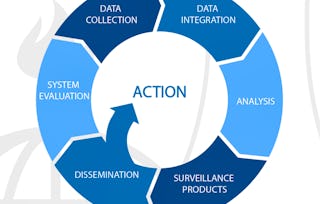
So we're switching gears today from communicable diseases to noncommunicable diseases, or often called, chronic diseases. I'll present some of the frameworks and approaches that have been developed to guide chronic disease surveillance and then I'll focus on giving different examples of these, ranging from cancer to cardiovascular health systems. Taking you back to the surveillance cycle from Dr. Gurley's course, "Surveillance Systems: Building Blocks," I'll provide some context on how these chronic disease surveillance systems can really impact chronic disease prevention strategies if communicated effectively. And that brings us back to communication, where we will again focus on approaches to communicate these complex issues and then give an example of how to apply communication framework in the context of a chronic disease.
What's included
8 videos1 assignment1 discussion prompt
Show info about module content
8 videos•Total 44 minutes
Introduction to Chronic Disease Surveillance Systems•1 minute
Chronic Disease Prevention Strategies•12 minutes
Centers for Disease Control (CDC) Surveillance Systems•4 minutes
Data Sources in Chronic Disease Surveillance•13 minutes
Chronic Disease Surveillance Targets•8 minutes
Surveys in Chronic Disease Surveillance•4 minutes
Summary•2 minutes
Assignment•1 minute
1 assignment•Total 30 minutes
Chronic Disease Surveillance Systems•30 minutes
1 discussion prompt•Total 10 minutes
Surveillance System Development•10 minutes
Special Surveillance Systems
Module 4•2 hours to complete
Module details
In this module, I will discuss some of the really interesting special surveillance systems. Although having standardized approaches for infectious diseases and non-communicable diseases is fundamentally important, there are also some health issues that do not fit nicely into these boxes, and it's here where these special surveillance systems can really play an important role. As you will see, having a framework or approach to the issue is still relevant, but the approaches are really tailored to the issue at hand. We will start by discussing syndromic surveillance systems, including when to use them and also how to design them. We'll then really evaluate the differences between indicator versus event-driven surveillance systems. We'll then move on to anti-microbial resistance surveillance systems and then talk in more detail about event-related surveillance systems.
What's included
9 videos1 assignment1 discussion prompt
Show info about module content
9 videos•Total 46 minutes
Introduction to Special Surveillance Systems•2 minutes
Syndromic Surveillance Systems Overview•5 minutes
Syndromic Surveillance•10 minutes
Indicator vs. Event-Based Surveillance System•6 minutes
The mission of The Johns Hopkins University is to educate its students and cultivate their capacity for life-long learning, to foster independent and original research, and to bring the benefits of discovery to the world.
When will I have access to the lectures and assignments?
To access the course materials, assignments and to earn a Certificate, you will need to purchase the Certificate experience when you enroll in a course. You can try a Free Trial instead, or apply for Financial Aid. The course may offer 'Full Course, No Certificate' instead. This option lets you see all course materials, submit required assessments, and get a final grade. This also means that you will not be able to purchase a Certificate experience.
What will I get if I subscribe to this Specialization?
When you enroll in the course, you get access to all of the courses in the Specialization, and you earn a certificate when you complete the work. Your electronic Certificate will be added to your Accomplishments page - from there, you can print your Certificate or add it to your LinkedIn profile.
Is financial aid available?
Yes. In select learning programs, you can apply for financial aid or a scholarship if you can’t afford the enrollment fee. If fin aid or scholarship is available for your learning program selection, you’ll find a link to apply on the description page.