Welcome to Exploring Beethoven's Piano Sonatas Part 6! You’re joining thousands of learners currently enrolled in the course. I'm excited to have you in the class and look forward to your contributions to the learning community.
To begin, I recommend taking a few minutes to explore the course site. Review the material we’ll cover each week, and preview the assignments you’ll need to complete to pass the course. Click Discussions to see forums where you can discuss the course material with fellow students taking the class.
If you have questions about course content, please post them in the forums to get help from others in the course community. For technical problems with the Coursera platform, visit the Learner Help Center.
Good luck as you get started, and I hope you enjoy the course!
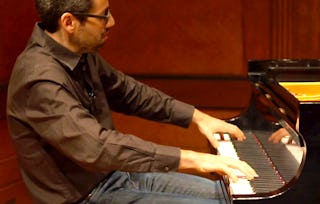
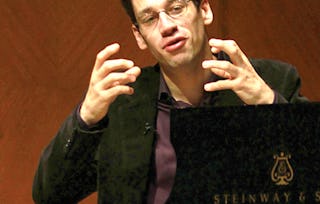
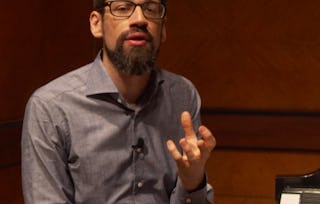
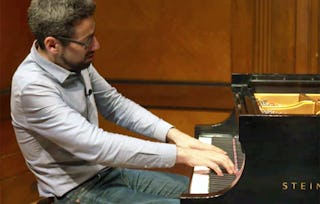
WELCOME TO CLASS! We are thrilled that you have joined us for Part 6 of Exploring Beethoven's Piano Sonatas course, taught by Jonathan Biss, Chair of Piano Studies at the Curtis Institute of Music. Jonathan is recognized as a world-renown concert artist and musical thinker. This course is Part 6 of the existing series called Exploring Beethoven’s Piano Sonatas. As with all sections of this course, Part 6 contains new and separate sets of lectures. Specifically, we will dive into Beethoven's Piano Sonatas Opp. 14 and 49; Sonata Op. 31 No. 3; Op. 54; and Op. 111. It is important to remind you that it is not necessary to have taken the previous Exploring Beethoven's Piano Sonatas courses, in order to enroll in this one. We think you will be perfectly comfortable to start learning with Part 6 if you wish and continue backwards. Between these courses, there exists a large amount of additional resources and learning that might be helpful as you embark on Part 6. And of course, we strongly encourage you to take Parts 1, 2, 3, 4, and 5, if you have not yet. In the meantime, have a terrific time taking this class and Part 6 of Exploring Beethoven’s Piano Sonatas.
What's included
3 readings
Show info about module content
3 readings•Total 30 minutes
Welcome to Part 6 of Exploring Beethoven's Piano Sonatas!•10 minutes
Syllabus•10 minutes
Getting to Know You•10 minutes
Opp. 14 and 49
Module 2•2 hours to complete
Module details
What's included
11 videos1 assignment
Show info about module content
11 videos•Total 71 minutes
"The Sonatas Op. 49 and 14: The Exceptions that Prove the Rule of Beethoven's Ambition"•2 minutes
Op. 49 No. 2, 1st movement•6 minutes
Op. 49 No. 2, 2nd movement•5 minutes
Op. 49 No. 1, 1st movement•5 minutes
Op. 49 No. 1, 2nd movement•5 minutes
Op. 14 No. 1, 1st movement•11 minutes
Op. 14 No. 1, 2nd movement•7 minutes
Op. 14 No. 1, 3rd movement•5 minutes
Op. 14 No. 2, 1st movement•9 minutes
Op. 14 No. 2, 2nd movement•7 minutes
Op. 14 No. 2, 3rd movement•8 minutes
1 assignment•Total 30 minutes
Final Quiz - Opp. 14 and 49 - Quiz•30 minutes
Op. 31 No. 3
Module 3•1 hour to complete
Module details
What's included
10 videos1 assignment
Show info about module content
10 videos•Total 73 minutes
The Most Subtle Work in its Opus•3 minutes
1st mvt: An Opening that is Ambiguous, Wistful, and Mercurial•10 minutes
1st mvt: A Constant Dialogue between Seriousness and Play•7 minutes
1st mvt: A Return – and an Entire Movement – with an Emotional Question Mark•10 minutes
2nd mvt: A Modified Scherzo from the World of Opera•9 minutes
2nd mvt: Comedy and a bit of Melodrama•6 minutes
3nd mvt: A Menuet Playing the Role of a Slow Movement•10 minutes
4th mvt: A Joyous Depiction of a Hunt•10 minutes
4th mvt: Drama and Comedy, Butting Heads•4 minutes
4th mvt: A Coda That Revisits Many of the Work’s Concerns•6 minutes
1 assignment
Final Quiz - Op. 31 No. 3 - Quiz•0 minutes
Op. 54
Module 4•1 hour to complete
Module details
What's included
10 videos1 assignment
Show info about module content
10 videos•Total 53 minutes
The Odd Cousin in a Family of 32•3 minutes
In the Middle of the Heroic Middle Period, a Work of High Quirkiness•4 minutes
A Sonata of Two Movements – One More Irregular than the Other•3 minutes
1st mvt: A Menuet that is a bit Foursquare…•7 minutes
1st mvt: …and a Trio that Goes Hog-wild…•8 minutes
1st mvt: …and Finally, a Coda that Gives the Movement Emotional Heft•7 minutes
2nd mvt: A Slow-moving Perpetual Motion•2 minutes
2nd mvt: Rock-steady Motion; Peculiar Harmonic and Rhythmic Detail•8 minutes
2nd mvt: A Second Repeat Highlighting this Work’s Sly Strangeness•7 minutes
2nd mvt: The Movement’s Potential Energy, Thrillingly Unleashed•3 minutes
1 assignment
Final Quiz - Op. 54 - Quiz•0 minutes
Op. 111
Module 5•2 hours to complete
Module details
What's included
12 videos1 assignment
Show info about module content
12 videos•Total 99 minutes
Beethoven’s Farewell to the Piano Sonata, in Two Movements Without Real Precedent•5 minutes
1st mvt: Beginning in Mid-sentence, and in Extreme Emotional Distress•12 minutes
1st mvt: A Stark, Unison Theme That Dominates the Movement•6 minutes
1st mvt: Music of Extreme, Nearly Uninterrupted, Rigor and Fury•12 minutes
1st mvt: A Development even more Compact and Airless than the Exposition•6 minutes
1st mvt: A Major Key Ending that Brings No Hope•8 minutes
2nd mvt: A Wondrous, Wide-Eyed Answer to the 1st Movement’s Rage•7 minutes
2nd mvt: Three Variations, Moving the Theme Towards Ecstasy…•11 minutes
2nd mvt: …and a Fourth, Making it Otherworldly•7 minutes
2nd mvt: Beyond C Major; Beyond Variation; Beyond the Possible•9 minutes
2nd mvt: The Absence of a Continuation•14 minutes
2nd mvt: Beethoven, and Life’s Most Profound and Universal Experience•3 minutes
1 assignment
Final Quiz - Op. 11 - Quiz•0 minutes
Your Thoughts Welcome
Module 6•10 minutes to complete
Module details
What's included
1 reading
Show info about module content
1 reading•Total 10 minutes
Stay in Touch with Curtis Institute•10 minutes
Instructor
Instructor ratings
Instructor ratings
We asked all learners to give feedback on our instructors based on the quality of their teaching style.
The Curtis Institute of Music educates and trains exceptionally gifted young musicians to engage a local and global community through the highest level of artistry. A tuition-free policy ensures that talent and artistic promise are the only considerations for admission. With a small student body of about 175, Curtis ensures that each young musician receives an education of unparalleled quality, distinguished by personalized attention from a celebrated faculty and a “learn by doing” philosophy. Curtis students hone their craft through more than 200 orchestra, opera, and solo and chamber music offerings each year in Philadelphia and around the world.
When will I have access to the lectures and assignments?
To access the course materials, assignments and to earn a Certificate, you will need to purchase the Certificate experience when you enroll in a course. You can try a Free Trial instead, or apply for Financial Aid. The course may offer 'Full Course, No Certificate' instead. This option lets you see all course materials, submit required assessments, and get a final grade. This also means that you will not be able to purchase a Certificate experience.
What will I get if I purchase the Certificate?
When you purchase a Certificate you get access to all course materials, including graded assignments. Upon completing the course, your electronic Certificate will be added to your Accomplishments page - from there, you can print your Certificate or add it to your LinkedIn profile.
Is financial aid available?
Yes. In select learning programs, you can apply for financial aid or a scholarship if you can’t afford the enrollment fee. If fin aid or scholarship is available for your learning program selection, you’ll find a link to apply on the description page.